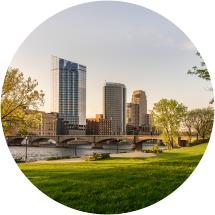



Grand Rapids is in the midst of one of the largest active riverfront revitalization efforts in the U.S., with seven new development projects totaling more than $1.2 billion of investment springing up around the Grand River in downtown Grand Rapids and beyond.
Dream Grand and Grow, a 90-second video from Experience Grand Rapids, showcases these developments through a clever mix of animation and real-life footage. What the video doesn’t have time to show are the many accessibility features being built into each project. Grand Rapids, previously recognized as a Top 10 Best City for People with Disabilities, is committed to becoming an even more safe, welcoming and enjoyable destination for ALL residents and visitors.
Here’s a look at some of the accessibility features at each development. More will be revealed as each project comes to fruition!


Lyon Square's renovation included adding a covered Grand River overlook, outdoor fireplace, public seating, additional tree canopy, lighting fixtures and a sidewalk snowmelt system to the plaza.
Photo by Sarah Goodwin for Experience GR
Lyon Square Renovation
Lyon Square is a pedestrian-focused park and plaza located between DeVos Place Convention Center and the Amway Grand Plaza, Curio Collection by Hilton Hotel. A $12 million renovation project was completed in summer 2025 and included adding a covered Grand River overlook, outdoor fireplace, public seating, additional tree canopy, lighting fixtures and a sidewalk snowmelt system to the plaza.
Disability Advocates of Kent County (DAKC), a local nonprofit aspiring to achieve equal access and opportunity for individuals with disabilities, is (or was) involved in every development profiled here. For Lyon Square, DAKC met with the designers, reviewed the design drawings, and provided guidance on ADA compliance and opportunities where Universal Design could be implemented. DAKC Test Pilots (volunteers with disabilities who assist in accessibility reviews) provided their onsite observations and recommendations for improving accessibility from a personal experience perspective.
The recommendations DAKC made during the Lyon Square design process typify the breadth and detail they bring to every project. Their Lyon Square recommendations included (but were not limited to):
- Installing curb-less sidewalks.
- Using color and texture as wayfinding aids and safety tools.
- Providing parallel-style curb ramps as opposed to diagonal-style curb ramps at intersections.
- Ensuring slopes are less than 5% grade along the circulation routes.
- Providing seating and respite areas, dispersed along circulation routes.
- Providing shelter from heat and intense sunlight/tree-cover, dispersed along the circulation routes.
- Discouraging the use of grass for accessible routes.


The Spillman Carousel features a new wheelchair-accessible chariot.
Photo by Bryan Esler for Experience GR
Grand Rapids Public Museum Enhancements
The Grand Rapids Public Museum, a three-story riverfront facility where history, science and culture come to life, is transforming its outdoor space into a more park-like environment. It is also detaching the pavilion housing its 1928 Spillman Carousel from the main building to allow for an accessible riverfront trail.
The carousel itself features a new wheelchair-accessible chariot, with a bench seat that folds up on one side, leaving the other seat for a friend or family member. The ramp leading up to the chariot and other ramps along the riverfront exceed ADA standards for slope, allowing for self-propulsion in wheelchairs as well as easy maneuverability of mobility devices, wagons and strollers.
Two new universal design river access points on the north and south sides of the Museum property feature low gradient pathways that allow for seasonal access for shore anglers and wading anglers. The design encourages dispersed angling and allow for safe river access by foot along the entire 600 feet of frontage. Additionally, a new outdoor classroom has terraced seating with cut-out spaces where someone with a wheelchair can sit alongside their peers.
The new Cook Carousel Pavilion and river’s-edge improvements were completed in spring 2026.
Acrisure Amphitheater
The 12,000+-seat Acrisure Amphitheater is an outdoor concert and performance venue on the banks of the Grand River. Opening in May 2026, the facility offers concourse, terrace and lawn seating, with three-quarters of the seats covered by an innovative canopy that provides both shelter from the elements and an unobstructed view of the stage from any vantage point.
Progressive Companies, a locally based design, architecture and engineering firm, designed the amphitheater in accordance with Michigan Barrier Free design requirements, National ADA Law and Universal Design Strategies to remove barriers and create an equitable experience for everyone. Progressive’s design team gathered input and lessons learned from operators of similar venues and locally from DAKC experts in the design and planning process. DAKC Test Pilots provided their observations and recommendations for improving accessibility from a personal experience perspective.
Accessibility features include a main level that is even with the street level to eliminate barriers to entry. Concourses are wide, with plenty of room to navigate for people using wheelchairs or other mobility aids, and accessible seating is dispersed throughout the facility. Elevators and ramps are located directly adjacent to stairs to offer equal experiences and common meeting points for people with a variety of physical abilities. Bilingual wayfinding signage and color identifiers enhance communication and accessibility.
Amway Stadium
Progressive Companies also designed Amway Stadium, an 8,500-seat multi-use stadium that will serve as home to Athletic Club Grand Rapids, an MLS Next Pro soccer team, when the team begins play in spring 2027. Once again, Progressive consulted DAKC during the design process, and DAKC Test Pilots with extensive personal experience attending major sporting events and the accessibility of such venues and their ticketing processes provided observations and recommendations for improving accessibility from a personal experience perspective.
The stadium was also designed in accordance with Michigan Barrier Free design requirements, National ADA Law and Universal Design Strategies, and it incorporates many of the accessibility features that distinguish the Acrisure Amphitheater. The planning of each facility creates a uniform flexible design that is easy to navigate, providing an enjoyable experience for all patrons.
Stadium finishes, colors and textures combine with directional and wayfinding signage to identify travel paths and clarify circulation routes. The circulation concourse leverages the intuitive nature of wayfinding to reduce potential confusion and clarify routes.
Grand River Restoration
Planning continues on an ambitious project to reimagine the Grand River that runs through downtown and transform the way people engage with it. The city’s namesake rapids, long absent from the river, will be restored with the removal of downtown dams that were placed in the late 1800s and early 1900s. Restoring the river to a more natural state will increase recreation opportunities and access for all potential users.
DAKC has consulted with Grand Rapids Whitewater, a local nonprofit spearheading this effort, and Downtown Grand Rapids Inc. to provide guidance on making new river interaction points as accessible as possible.
Grand River Greenway
The Grand River Greenway is a growing network of public parks, trails and natural areas linking West Michigan communities to the Grand River. When finished, the Greenway will travel straight through Grand Rapids on its 85-mile route from Lowell to Lake Michigan.
Accessibility is a key aspect of this regional effort, as many partners are working together across Kent County and Ottawa County to increase access to and along the Grand River, with the aim to provide more places for people of all abilities to experience the river corridor by walking, rolling, biking, paddling, fishing and other activities.
The focus of regional partners over the next several years is to complete the primary trail connections that will link the system together. All trail projects are ADA accessible and seek to be universally designed wherever possible – ensuring that trail widths, slopes, surface materials, access points, parking, signage and other supporting amenities (such as restrooms, picnic areas and playgrounds) are designed and built for people of all ages and abilities.
Projects also seek to improve access to the Grand River by adding more places where people can safely interact with the river through accessible fishing docks, kayak launches and additional places to get to the river’s edge to sit, swim or wade near the river. To that end, the development of the Greenway also includes enhancement of the Lower Grand River Water Trail – a state-designated water trail with 96 miles and 35 access points from Portage to Grand Haven.
The river’s-edge enhancements undertaken by the Grand Rapids Public Museum are part of the Grand River Greenway. So is downtown GR’s Canal Park, which will reopen in summer 2026 with a new universally accessible play space, accessible kayak launch and 14-foot-wide multi-use paved trail that provides connections between downtown and the city’s Monroe North and Creston neighborhoods.
Johnson Park, about 10 minutes from downtown GR, is also part of the Greenway. In 2026, the park will unveil eight miles of adaptive natural-surface trails. Designed in partnership with the West Michigan Mountain Biking Alliance and Kent County Parks/Parks Foundation, the trails will be open to mountain bikes customized for physical or sensory needs as well as traditional mountain bikes.
Additional 2026 improvements include replacement of a restroom building with a new four-season, universal design restroom and a fully accessible playground (in partnership with the Michigan Natural Resources Trust Fund).
Visit grandriver.network/projects for comprehensive project details and updates on the Kent County stretch of the Grand River Greenway.
Fulton & Market Towers
Fulton & Market Towers is a proposed 31-acre skyline-defining mixed-use high-rise riverfront project in downtown GR. The design process has not yet begun, but DAKC has met with the parties involved, who are committed to engaging the organization and its Test Pilots from the outset of the design process, likely in late 2026.
In addition to incorporating accessibility into these (and other) future projects, Grand Rapids and Kent County continue to promote and enhance accessibility at existing attractions, hotels and restaurants. Read more about our accessibility efforts and consult the Accessible Grand Rapids page on Wheel the World, an online accessible travel platform, for comprehensive accessibility information about 50+ local tourism-related businesses.
Our thanks to the contributors to this article: Hilarie Carpenter, Regional Director of Legends Global; Matt Chapman, Executive Director of Grand Rapids Whitewater; Bill Culhane, Architect/Principal at Progressive Companies; Kim Davey, Community Engagement & Advocacy Manager at Disability Advocates of Kent County; Delany Lemke, Grand Rapids Public Museum Marketing Manager; Kara Wood, Executive Director of Grand Action 2.0; and Catherine Zietze, Grand River Greenway Project Manager for Downtown Grand Rapids Inc.