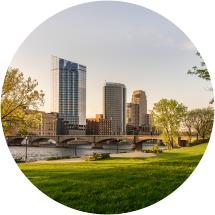



Grand Rapids was named one of the 14 most walkable cities in the U.S. a few years back, largely because of our amazingly compact and fun-filled downtown. There are more than 300 restaurants, shops, museums, breweries and entertainment venues within a 10-minute stroll of 13 downtown hotels.

One of the best ways to experience downtown is to embark on your own self-guided walking tour. We’ve got suggested routes to help you explore Community Legends Sculptures, Center City Murals, Heartside Murals, Holiday Lights, Painted Ticket Booths, Rad Women Electrical Boxes and Historic Buildings. We also have two sculpture tours – Downtown East and Downtown West – covering either side of the Grand River.

Our Downtown Walking Tour (below) minimizes the time you’ll spend on sidewalks and walking paths, traversing just 10 or so city blocks and less than one mile. But the sights you see will transport you all the way from outer space to the inner workings of the American presidency.

Exploring with Finny the Whale.

Stop inside the Grand Rapids Public Museum to explore the history of Grand Rapids.

Photo by Experience Grand Rapids

Grand Rapids Public Museum

Start at the Grand Rapids Public Museum, which is just across the Pearl St. Bridge from the Amway Grand Plaza and JW Marriott hotels. The GRPM tells the stories of West Michigan and the wider world through historical and cultural artifacts, permanent installations and touring exhibitions. Visitors can travel back to the 1890s on the Streets of Old Grand Rapids, ride a newly refurbished 1928 Spillman Carousel, learn about the indigenous People of This Place and the waves of Newcomers that settled here later, explore West Michigan’s unique Natural Habitats, journey through the cosmos in the Museum’s Roger B. Chaffee Planetarium and much more.

Oh, and be sure to look up as you poke around the first floor Galleria of the three-story facility – you’ll see the skeleton of a 75-foot finback whale (dubbed “Finny”) that washed ashore on Florida’s Gulf Coast more than a century ago. GRPM acquired the skeleton in 1905 and it’s been a centerpiece of the Museum ever since. In 2025, the Museum debuted a skeleton that was found a little closer to home – the Clapp Family Mastodon, discovered in 2022 in Newaygo County, about 20 miles from the Museum. It’s also on the first floor.

Founded in 1854, GRPM moved from another downtown site to this beautiful riverfront setting in 1994 – and it is now completing phase one of a $50 million renovation that has added an accessible chariot to the Spillman Carousel, created outdoor exhibit space, expanded access to the Grand River and more.

Gerald R. Ford Presidential Museum

Just across Pearl St. from GRPM is the Gerald R. Ford Presidential Museum, a tribute to the 38th president of the United States. Ford grew up in Grand Rapids and represented the area in Congress for 25 years, and his namesake Museum contains more than 19,000 historic artifacts from his youth and his one-of-a-kind political career.

Dubbed “America’s most entertaining presidential museum,” the Museum features state-of-the-art technology-based exhibits, including a thrilling multimedia simulation of the 1944 typhoon that nearly swept Ford off the deck of the USS Monterey aircraft carrier during World War II.

There’s also a replica of the White House Oval Office – you can stand behind the president’s desk – plus a section of the Berlin Wall, the original Watergate burglar tools and more. Touring exhibitions illuminate Ford’s impact and the times in which he lived.

The President and First Lady Betty Ford are interred on the grounds of the Museum, and many visitors stop at the gravesite to pay their respects to the couple.

Family picnic at Ah-Nab-Awen Park

Ah-Nab-Awen Park is the perfect spot for resting, relaxing and picnicking, just be sure to keep off of the mounds to prevent damage.

Photo by Ideology for Experience GR

Ah-Nab-Awen Park

The Gerald R. Ford Presidential Museum looks out over Ah-Nab-Awen Park, a gorgeous greenspace fronting the Grand River. Ah-Nab-Awen means “resting place” and it was originally home to a series of burial mounds built by the Hopewell indigenous peoples between 450 B.C. and 450 A.D. Today, three symbolic earthen mounds in the park represent the three major indigenous tribes of Michigan: the Ottawa, Potawatomi and Chippewa. (Please keep off the mounds to prevent damage.)

Much of Ah-Nab-Awen Park will be closed starting in spring 2026, as construction crews use it as a staging ground for an ambitious project to restore the historic Grand River rapids that gave the city its name. However, a southern portion along Pearl St. – where the earthen mounds are located – will remain open. That’s where the earthen mounds are located, and it’s also the home of the Spirit of Solidarity Labor Monument commemorating the Grand Rapids furniture worker’s strike of 1911. Grand Rapids was then known as the Furniture Capital of the World, and local manufacturers employed thousands of skilled local residents, many of them immigrants. An estimated 4,000-6,000 workers went on strike for higher wages from April through August of 1911, but never did win the demands they sought.

Amway Grand Plaza Hotel

Follow Pearl St. east across the bridge to the Amway Grand Plaza, Curio Collection by Hilton. This AAA Four-Diamond hotel blends the elegant history of the 1920s Pantlind Hotel – named one of America’s 10 Finest Hotels in 1925 – with the modern amenities of today. The Pantlind side of the hotel showcases the Old World glamor of its original era, with three magnificent chandeliers made of Austrian crystal, a domed ceiling featuring the largest gold leaf installation in the U.S, a wooden-gilded sunburst that hung in the ballroom of wealthy Italian merchant for 150 years, and many other Art Deco-influenced details.

Need a refreshment break? The Amway has plenty of dining and sipping options to choose from: The Kitchen By Wolfgang Puck, The Kitchen Counter by Wolfgang Puck, Rendezvous, IDC and Lumber Baron bars, and MDRD, perched at the top of the hotel’s soaring 27-story glass tower. MDRD was named the #2 best new restaurant in the country by USA Today in 2021, and it’s epic casual dining experience.

You could also check in to the hotel’s Celeste Salon & Spa, play RoofTop pickleball or enjoy a game of duckpin bowling – you don’t have to be a hotel guest to partake of these amenities, visit the restaurants or just admire the lavish interior.

Swing dancing at Rosa Park Circle.

From dancing to ice skating, Rosa Parks Circle is a hub for community, hosting many public events.

Photo by Brian Kelly for Experience GR

Rosa Parks Circle

Exit the Amway Grand on Pearl St. and head east to the Monroe Ave. intersection. Cross the street and go right to Monroe Center St. To your right is Rosa Parks Circle, a public plaza designed by Maya Lin, who also designed the Vietnam Veterans Memorial in Washington, D.C. Lin celebrated the city's connection to water by representing it in three forms: liquid (flowing water), vapor (a mist fountain), and solid (ice).

Named one of America’s Top 5 Great Public Spaces in 2017, Rosa Parks Circle hosts a wide variety of public events in warm weather – festivals, concerts, swing dances, lunch programs and more –and it converts to a public ice rink in winter.

The plaza was named for civil rights activist Rosa Parks in 2011 and a statue of Parks was dedicated at the entrance to the space in 2010.

That’s the end of our tour – but you’re now perfectly positioned to explore even more of the city, from the Grand Rapids Art Museum (on the edge of Rosa Parks Circle) to the many shops and restaurants that line Monroe Center St.

Photo of the blue bridge in downtown Grand Rapids.

Use the Blue Bridge to explore the city and the river.

Photo by Nick Irwin for Experience GR

The Blue Bridge

Follow Monroe Ave. south to Campau Ave. and cross at the intersection. Just past a sign for The Plaza Condominiums is a paved path leading to a bright blue structure. (You can see it from Campau Ave.) Take the path to the Blue Bridge, one of downtown’s most photographed landmarks.

Originally constructed in 1892 as a bridge for the Grand Rapids & Indiana Railroad, the Blue Bridge is now a pedestrian path connecting the east and west sides of downtown Grand Rapids over the Grand River. Abandoned by the railroad in the 1980s, the bridge was acquired by the city and renovated for pedestrian use. It was originally set to be painted bronze, but locals quickly warmed to the bright blue primer the city laid down as a first coat – it’s strikingly similar to “Laker Blue,” the color of Grand Valley State University, whose downtown campus stands at the west end of the bridge. Today, the bridge lights up in all sorts of different colors after dark to mark occasions like Independence Day and support health awareness campaigns.

Cross the bridge and you’ll encounter a sculpture of Chief Noonday, who led the Grand River Band of Ottawa Indians. When traders arrived in the greater Grand Rapids area, this American Indian leader helped welcome new settlers.

Now you’re just a few hundred feet from the entrance to the Grand Rapids Public Museum, where you started this tour.

Looking for a guided tour of downtown? Check out Tours Around Michigan , which conducts public and private tours exploring downtown GR history, art, architecture, breweries, ghost stories, churches and more.